

Travis Keating sets the new catch and release record with Rainy River Giant
We knew it was going to happen soon. Rumors of record-breaking sturgeon have been circulating for the last couple of years. A supposed record-breaker was caught last year but it wasn’t submitted correctly for the record and Darren Troseth’s 78″ fish from the St Croix remained in the top spot. Watch Darren catch his record fish here.

Until now. On April 18th, during a cold trip to the Rainy River, Travis Keating and friends were fishing Four Mile Bay for sturgeon. The group caught 7 smaller fish before moving towards the mouth of the river. That’s when Travis hooked the record fish. The fight, described as chaos according to the MN DNR press release, lasted an hour. The fish measured 80″ and was registered with the state.
The comments about this fish are wide ranging, with many inquiring about it’s age and, unfortunately, the hold in the photo. We’re not sharing it here because we discourage holding them vertically by the gills, but you can find it by searching. I get asked constantly about the age of sturgeon, so I went down a rabbit hole to do some research.
What Might Be A Better Sturgeon Fishery Than The Rainy?

While Minnesota is reknowned for it’s sturgeon on the Rainy and St Croix, there are a number of other river systems that you can catch them on. From the St Louis and Otter Tail, to the Red, Minnesota and Mississippi. But our neighbor to the east may have some of the best sturgeon research around.
Should Sturgeon be on the Endangered Species List?
Wisconsin’s Lake Winnebago has been managed as a sturgeon spearing fishery for about a hundred years, starting in 1932. There is no angling allowed. This is partly to honor the Native American traditions, but also because of the tradition that spearing sturgeon there has become for everyone else. It’s a great time and a tightly managed resource. Some massive fish have been swimming in those waters for decades. With another recent anti-fishing attempt by the Center for Biological Diversity to put them on the Endangered Species List, it’s important to remember that the spearing tradition is what has protected them for so long. Without the spearers, those fish would not enjoy the strict management they currently have.
This is the third attempt in 8 years to get them listed. In 2024, the US Fish and Wildlife service issued a 12-month finding that said it wasn’t needed. In 2017, the Committee on the Status of Endangered Wildlife in Canada determined that lake sturgeon in the Nelson River watershed including Lake of the Woods and the Rainy River were endangered. They were lumping the Rainy River fish in with other locations that may have lower population densities. Thankfully, the Minister of Environment said consultation with the province was needed before any recommendations were taken, since the Rainy River population is booming.
Check out our new merch! Click here to visit the Fish Hunt Forever Store!


They did this after Minnesota and Ontario officials agreed that short-term recovery goals had been met in 2012. (Reference) New goals for long-term recovery are to be evaluated in 2030 according to the same report. Currently, it’s illegal to target sturgeon on the Canadian side of the Rainy River.
See Minnesota regulations on sturgeon, dates, tags and more here.
Watch Fish Hunt Forever Rainy River Fishing Videos:
2026 | 2025 | 2024 | 2023 | 2022
How Long Does It Take A Sturgeon To Grow
I dug into research from the Wisconsin biologists along with the Minnesota DNR’s to learn more about the aging process. In the Winnebago system, it takes about ten years for sturgeon to grow to 36“. Twenty years to get to 50″ and fifty years or more to get to the 70” mark.
They also found that because of the robust round goby population there, sturgeon are reproducing at younger ages, according to a recent Outdoor News article. The biologist Ron Bruch states that they begin spawning there between the ages of 14 – 20, instead of 20 – 30. They also mention that sturgeon have been found to spawn in water temps ranging from 38 – 70 degrees and exist all across North America. They are not in any danger and Bruch should know, he’s worked on sturgeon recovery projects in 12 countries.
Anyone who’s spent time on the Rainy River in recent years will agree. Our Annual SJR500 tournaments have shown large numbers of sturgeon being caught. In 2024, two different boats caught over 50 sturgeon in the two-day tourney. The sizes are getting bigger as well.
This year our winning fish was 67.5″, while last year’s was 71.5″. A 75″ fish was reported after our event ended. And now we have the 80″ behemoth.
How Old Are Sturgeon On The Rainy River

I’ve been crediting the Clean Water Act of the 1970’s and the end of commercial sturgeon and caviar fishing in the 1980’s with the burgeoning population we enjoy today. It seems as though a lot of the fish we’re seeing are from that era.
In that 2024 SJR500 tournament, Paul Johnson of River Bend Resort caught a 62″ sturgeon that was tagged. (Click here to see it) It was just under 40″ when it was tagged 20 years earlier. So it grew just over 1″ per year. Which is actually a bit faster than I would have expected. It was 36 years old at 62″.
That tells me that the majority of the sturgeon in the Rainy aren’t quite as old as some might think. Sure they can live long past 100, but most of these are probably in that 30-60 year range. Which, would make them Gen X fish, born in that 1960’s – 1980’s timeframe. Once you get into the 70’s and 80’s, the growth slows, so they could be a bit older.
Minnesota DNR Sturgeon Research

In the Fall of 2003, Phil Talmadge and the DNR studied sturgeon between Birchdale and Wheeler’s Point. They netted 98 fish over 36 days. The longest two were both 63″ and the average size was 47.6″. With a very low allowable harvest and safe fish handling measures, those could be some of the big fish we’re seeing today. (Reference)
In 2006, the USGS studied sturgeon on Rainy Lake. They captured 322 sturgeon, with 50 recaptures. The nets were too big to capture young sturgeon, so most were between 43″ and 59″. Very few were older than 50 years, with the oldest being 59 years old. (Reference)
A couple years ago, Brad Dokken caught a tagged sturgeon that he wrote about in this article. It was 55″ and 30 years old. That fish only grew 3″ in 6 years.
How Do They Know How Old Sturgeon Are
Food, water temps and genetics will determine how fast a fish grows. While growth rates may differ among fish, one constant remains in this research. These fish seem younger than we might think, but aging sturgeon can get a little difficult without tagging information.
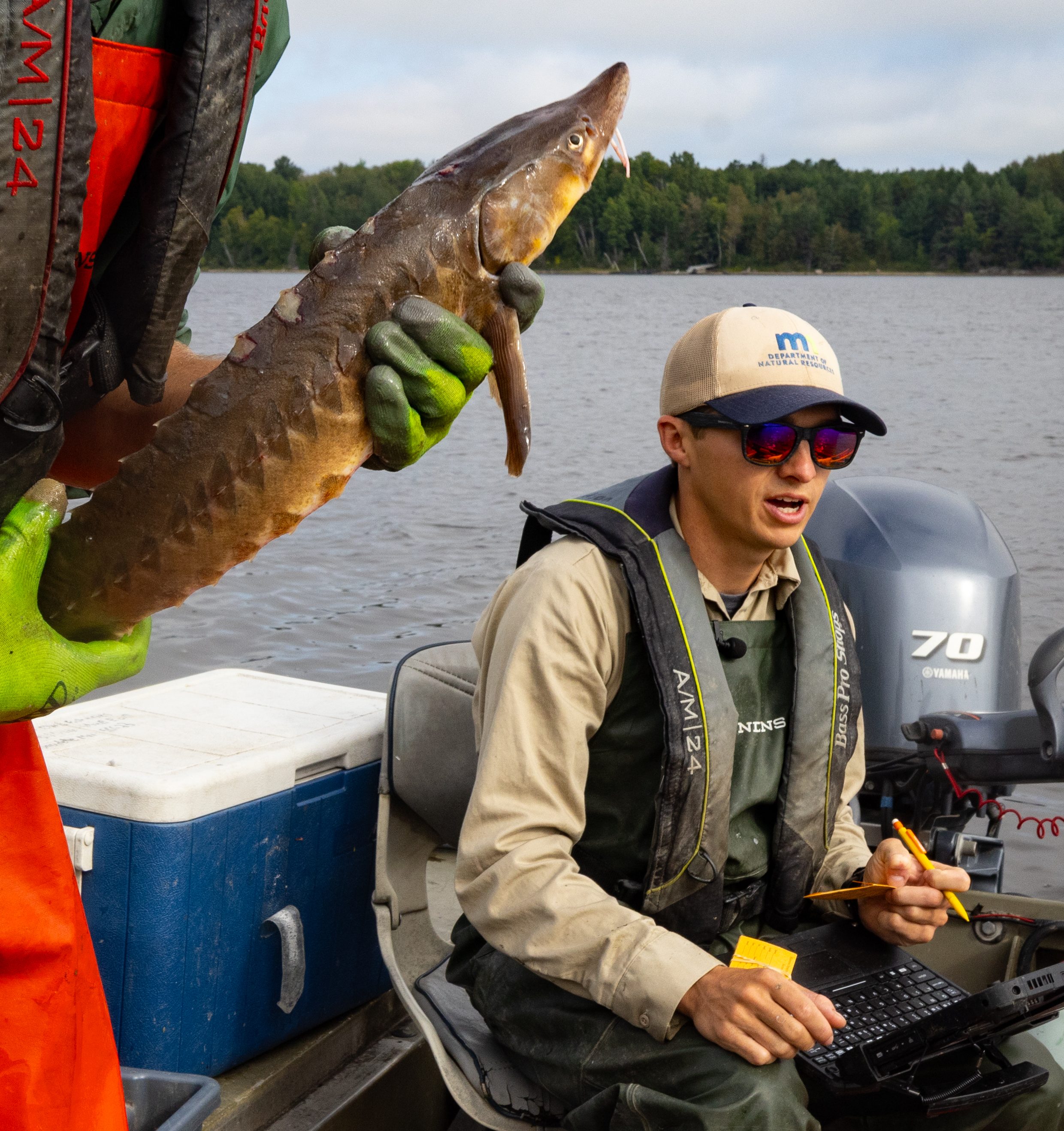
Young sturgeon are aged by clipping a ray off their pectoral fin. They can count the growth rings in the ray. Once they reach 14, it gets more difficult. We learned about this on this episode of Prairie Sportsman, where we filmed the DNR netting and tagging sturgeon on the Rainy River.
We also dropped a hydrophone in the water to listen for tagged sturgeon. Fish #39542 swam by, it’s signature series of beeps came from a speaker and we were able to get the data from that fish. It was 19.1″ long when tagged in 2024. They’d detected that fish multiple times all in the same general area.
How Much Do Sturgeon Travel

The research is starting to reveal more about the movements of these dinosaurs. Most stick close by when they’re young, but as they get older, they might travel long distances. We learned about one that traveled from the Big Falls all the way out into Lake of the Woods. In the past, we’ve heard about sturgeon going from Otter Tail to Lake Winnipeg and others that travel all over Lake of the Woods from the Canadian Side to the US.
The Minnesota DNR has done a great job of protecting lake sturgeon. The Rainy River managment plan protects 30 – 50+ year old fish for the best reproductive success. Their research indicates that males reach maturity at 17 and females at 26. Males spawn every 2-3 years, while females are every 3-6. So while they may grow fast, they reproduce slowly. It’s also why it’s important to be cautious around spawning areas when sturgeon are present. It’s quite the sight, but let them do their thing.
Should You Keep A Sturgeon
I also encourage you to try keeping one. They can be delicious to eat and the short harvest window on sturgeon of one between 45″ – 50″ (or over 75″) keeps the population strong. To give you an idea of how they are doing, there were 16,000 fish over 40″ in 1990. In 2004, the DNR research shows that population grew to 60,000 and today they figure there is 100,000 of them. We filmed an episode about it with Phil Talmadge and Jamie Dietman that you can watch here:
There were 1,000 pounds harvested each year in the 1990’s. That grew to over 13,000 pounds in 2003. In 2006, they began a tag system to manage this opportunity. The harvest threshold is 11,600 pounds and the average harvest levels from 2018 – 2023 was only 5,370 pounds. So we’re not even keeping half of what they consider sustainable.
It’s estimated that a 45″ fish is 19 years old and will weigh around 20 lbs. This means that the average age and weight of harvested sturgeon on the Rainy River are 19 – 23 years old and weigh 20 – 30 pounds. Which, by my math, means a little over 200 fish are kept annually. Not much to worry about when there’s at least 99,800 others still swimming.
Catch and Release Works
Mortality on caught-and-released sturgeon is low, with many tagged fish reportedly caught multiple times and released. That comes with safe handling measures of course and we encourage you to research the best methods for handling sturgeon. Use a big net, don’t ever hold them vertically by the gills and get them back in the water quickly. They’re pretty tough fish overall, but there is worry about gill holds, similar to other fish. Vertical holds on any big fish is bad as their head and necks can’t always support all the weight.
The new state record was 80″ long with a 38″ girth and is estimated to be over 160 pounds. A horizontal hold on a fish like that is recommended. Most people will rest them on their laps for the picture. Congrats to the state record holder and if you plan to fish the Rainy River any time in the near future, be prepared in case you catch the next state record!
























Leave a Reply